
News
Stay up to date on the latest crypto trends with our expert, in-depth coverage.

1Bitget UEX Daily | US-Iran Sign Electronic Agreement; SpaceX Market Cap Surges and FAB10 Concept Emerges; Nvidia Issues Bonds to Expand AI Capacity (June 16, 2026)2Hormuz Strait Reopens: Will the Federal Reserve Pivot Dovishly and Will the Market Reprice Rate Cuts?3US Stock Market Financing Hits Historical Limit! Morgan Stanley Warns: A Deleveraging Storm is Brewing
Spot bitcoin ETF inflows net record $1 billion in a single day
On March 12, net bitcoin ETF inflows hit over $1 billion.Blackrock’s IBIT product saw a record $849 million inflow.
The Block·2024/03/13 07:38

QCP Capital Weekly: Asia Morning Colour – 13 Mar 24
QCP Capital·2024/03/13 06:58

MakerDAO founder announces two new tokens in 'Endgame' launch details
The launch will be accompanied with two new tokens, tentatively named NewStable and NewGovToken. The DAO will explore ways to differentiate the new stablecoin from the existing Dai token.
The Block·2024/03/13 06:36

BONK’s Market Cap Surpasses WIF: Is This the End of the Battle?
Coinedition·2024/03/13 06:28

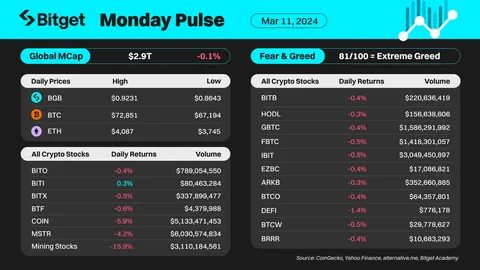
BTC Surpassed $72K, ETH Crossed $4K
Bitget·2024/03/13 06:04

Bitcoin Price Resumes Rally As The Bulls Now Aim For $75K
Newsbtc-eth·2024/03/13 05:22
Grayscale’s spot Bitcoin ETF market share falls to 50%
Cointelegraph·2024/03/13 01:41
Thai SEC Opens Doors to Private Funds for Spot Bitcoin ETFs, But There’s a Catch
Thailand regulator enables access to US-listed Bitcoin ETFs for institutions and high-net-worth individuals.
Cryptopotato·2024/03/12 23:55
After US bitcoin ETFs, the UK fights for retail to have the same freedom
The success of bitcoin ETFs in the US has created pressure for the FCA to reconsider its stance, 21.co executive says
Blockworks·2024/03/12 23:16
Flash
10:10
HIP-3 US Stock Gainers: SPCX Leads Gains, Storage Semiconductor Sector Shows StrengthBlockBeats News, June 16th. According to Hyperinsight Monitoring, as of June 16th, 18:00, in the Hyperliquid HIP-3 US stock market, SPCX (SpaceX) led the gains with a 12-hour increase of 7.25%, reaching a current price of $211.39. The 24-hour trading volume reached $1.129 billion.
Four of the top five spots are from the storage and chip sector: WDC (Western Digital) with a 12-hour increase of 5.20% ranked second; MU (Micron Technology) with a 12-hour increase of 3.34% and a pre-market increase of 3.62%, leading the pre-market session; the DRAM spot index rose by 1.98%; SKHX (SK Hynix) rose by 1.77%, showing overall strength in the storage industry chain.
09:57
SoftBank Partners with OpenAI to Launch AI Cybersecurity Service in Japan, Masayoshi Son Warns AI Attacks Could Lead to Japan's "Black Ship Crisis"BlockBeats News, June 16th. SoftBank Group announced on Tuesday that it will launch an AI-driven cybersecurity service for Japanese enterprises, aiming to meet the growing market demand for AI defense capabilities. The launch event took place on June 16th in Tokyo, where SoftBank Group CEO Masayoshi Son attended and delivered a speech.
At the event, Son warned that AI-driven cyber attacks could become Japan's "Black Ship Crisis" moment — referring to the historical event in the 19th century when American warships arrived to demand the opening of Japan's borders, implying that AI cyber threats could have a similarly disruptive impact on Japan.
The launch of this service comes at a time when the U.S. is restricting foreign expansion of competing AI models, and SoftBank's move is seen by observers as a strategic step to accelerate its presence in the Japanese AI security market amid a backdrop of geopolitical tech competition.
09:56
UBS Delays Fed Rate Cut Expectations to 2027, Anticipates Hawkish Signals This Week On June 16, UBS Global Wealth Management pushed back its expectations for Federal Reserve rate cuts to March and June 2027, no longer anticipating any cuts this year. The firm stated that this move reflects its judgment that this week's meeting will release hawkish signals. UBS now expects the Fed to cut rates by 25 basis points in March and June next year, compared to previous forecasts of cuts in December 2026 and March 2027. The Federal Reserve is set to announce its rate decision this week, marking the first meeting under new Chair Jerome Powell, with the market widely expecting rates to remain unchanged. UBS Global Wealth Management analysts noted in a report dated June 15, 'Although Powell has previously expressed a more dovish stance, we expect this meeting's tone to be more hawkish, both in the statement and the dot plot.' UBS indicated that major central banks are unlikely to hastily shift to a more dovish policy stance due to the U.S.-Iran agreement. Instead, as developments unfold and data released in the coming months gradually reveal whether energy shocks are triggering a second round of inflationary pressures, central banks are likely to maintain a cautious stance.
News