
News
Stay up to date on the latest crypto trends with our expert, in-depth coverage.

1Bitget UEX Daily | US-Iran Sign Electronic Agreement; SpaceX Market Cap Surges and FAB10 Concept Emerges; Nvidia Issues Bonds to Expand AI Capacity (June 16, 2026)2Hormuz Strait Reopens: Will the Federal Reserve Pivot Dovishly and Will the Market Reprice Rate Cuts?3US Stock Market Financing Hits Historical Limit! Morgan Stanley Warns: A Deleveraging Storm is Brewing

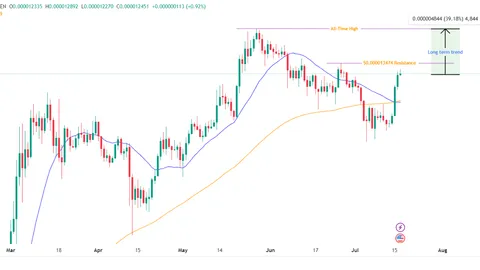
Kaspa (KAS) Aims to Extend Short-Term Rally as Price Eyes Monthly High
BeInCrypto·2024/07/17 14:56

Polygon’s New Liberty Cats Tops In Daily Sales – Stirs Up Suspicions Among Traders
Insidebitcoin·2024/07/17 14:23

US Bitcoin ETFs Registered Their Best Performance in 6 Weeks
Cryptodnes·2024/07/17 12:52
Worldcoin Soars 30%, Pepe Gains, XRP Eyes New Highs: Crypto Market Update
Coinedition·2024/07/17 12:34

2024 Crypto Futures Market Analysis: BTC and ETH Reign Supreme, Altcoins Struggle
Coinedition·2024/07/17 12:22

From Collapse to Comeback: Terra Classic (LUNC) Shows Signs of Revival
Coinedition·2024/07/17 12:22

Bitwise CIO predicts Ethereum ETF inflows will push ether prices to all-time highs above $5,000
Bitwise CIO Matt Hougan said spot ETF inflows could have a bigger impact on ether than they did on bitcoin.Hougan predicted that spot Ethereum ETF inflows will push ether’s price to all-time highs above $5,000.
The Block·2024/07/17 11:26

Chainlink (LINK) Network-Wide Accumulation Leads to 10% Jump in 7 Days
BeInCrypto·2024/07/17 09:29

Meme Coin Mania: Pepe (PEPE) Outperforms Dogecoin and Shiba Inu
Coinedition·2024/07/17 08:43

Exploring Omax Coin (OMAX): A Layer-1 blockchain based on POS
远山洞见·2024/07/17 08:24
Flash
08:51
SPCX Ranks Among Top HIP-3 Markets with Trading Volume Exceeding $1.125 Billion On the Hyperliquid platform, SpaceX tokenized stocks have become the highest trading volume HIP-3 market, ranking third in overall trading volume across the Hyperliquid platform. Data shows that SPCX has recorded a trading volume of $1.125 billion, making it one of the most actively traded HIP-3 assets in the current Hyperliquid ecosystem.
08:34
DeFi yield protocol Pyra ceases operationsForesight News reported that the DeFi yield protocol Pyra, affected by the Drift Protocol attack, has announced it will cease operations. Pyra stated that it has not found a sustainable way to continue after the incident and has currently suspended new user registrations. Existing users can withdraw funds before September 15. Pyra also mentioned that after Drift launches its "recovery tokens," they will be distributed to affected users through a web portal.
08:31
Apyx releases plan for 2.0 upgrade to restructure the redemption mechanism in response to stress tests and liquidity squeeze risks.BlockBeats reported that on June 16, Apyx officially launched the “Apyx 2.0” framework after undergoing the largest stress test since June. The framework systematically restructures the redemption mechanism, collateral structure, and transparency indicators to address previous risks of price depegging and redemption runs. Apyx stated that, after the protocol went live in February and expanded to a circulating scale of about $500 million, it recently faced significant market pressure: the STRC (its core collateral asset) experienced its largest historical drawdown, apxUSD briefly dropped to about $0.90 on secondary markets, and the protocol handled a large number of redemption requests, but overall maintained solvency. This stress test exposed that the core issue lay in the mechanism design of the over-collateralization buffer. Apyx pointed out that, in extreme market conditions, if redemptions are allowed according to net asset value (NAV), it creates a structural incentive of “early redeemers arbitraging while later holders bear the losses,” thus accelerating capital outflows and eroding the system buffer. To address this, Apyx 2.0 introduces a “dual value system” to replace the previous single NAV framework. In the new system, “Redemption Value” will serve as the unified pricing benchmark for all minting and redemptions and applies in both stressed and normal market conditions; while “Total Collateral Value” is used to display the total reserve scale, including the over-collateralized buffer. The protocol emphasized that the difference between the two is the transparent and visible risk buffer, but this buffer is no longer used directly for face-value redemptions, thereby eliminating the “risk-free arbitrage window” and avoiding systemic runs during market downturns. Apyx stated that this adjustment turns the buffer from a “priority arbitrage target” into a “continuously accumulating stabilizer.” Additionally, Apyx plans to introduce an RFQ (request-for-quote) redemption mechanism, allowing users to directly trade with counterparties through a quote-matching method during periods of market stress, in order to improve liquidity exit efficiency and reduce the price impact of automated redemptions.
News