Bitget App
Trade smarter
Buy cryptoMarketsTradeFuturesEarnSquareMore

News

Stay up to date on the latest crypto trends with our expert, in-depth coverage.

banner
All
Crypto
Stocks
Commodities & Forex
Macro
XRP's Strategic Price Reclamation: A Bullish Case Amid Regulatory Clarity and Ledger Upgrades

- XRP's 2025 strategy focuses on price reclamation above $2.94 amid regulatory clarity and technical upgrades. - SEC's Q3 2025 commodity reclassification unlocked $7.1B institutional flows and ETF approvals with 78-95% approval probability. - Ripple's XRPL upgrades attracted JPMorgan, Santander, and BNY Mellon for cross-border payments and RWA tokenization. - Whale accumulation and macro tailwinds suggest potential $5-$7 surge by mid-2026 if $2.94 support holds.

ainvest·2025/08/28 12:09
Ethereum Staking Dynamics and the Implications for ETH Price Momentum

- Ethereum's 2025 staking surge sees 29% of supply staked, generating $89.25B annualized yield, outpacing Bitcoin's zero-yield model. - 4.6B ETH queued for unstaking faces 17-day delays, but institutional ETFs absorbed 1.83M ETH/month, stabilizing price through strategic retention. - Dencun/Pectra upgrades enable 10,000 TPS at $0.08/tx, combined with CLARITY Act utility token status, reinforcing Ethereum's institutional infrastructure role over Bitcoin.


ainvest·2025/08/28 12:09
Decentralized Leadership and the Future of Industrial Governance: What MSTY's Silence Reveals About the Market's Next Frontier

- Decentralized governance is reshaping industrial sectors, with firms like Maersk reporting 15-35% efficiency gains through real-time decision-making and AI-driven collaboration. - Mynd Solutions (MSTY) remains silent on adopting this model despite heavy AI/blockchain investments, raising concerns about regulatory delays or strategic short-termism. - Investors face a dilemma: MSTY’s lack of governance reform risks being outpaced by competitors leveraging decentralized leadership for agility, while Deloitt

ainvest·2025/08/28 12:00
The Semiconductor Renaissance: How SoftBank's $2 Billion Intel Bet Signals AI's Next Frontier

- SoftBank's $2B Intel investment signals confidence in AI-driven semiconductor demand, aligning with Intel's U.S. manufacturing and tech pivot. - U.S. government support via CHIPS Act and Trump-era equity stakes creates a $10.9B public-private partnership to bolster semiconductor independence. - Intel's stock rebound and strategic AI infrastructure bets highlight the sector's consolidation phase, urging investors to prioritize semiconductor leaders and AI infrastructure. - Risks include stiff competition

ainvest·2025/08/28 11:54
Navigating the Storm: China's Digital Currency Caution and the Future of Stablecoin Investments

- Zhou Xiaochuan warns stablecoins pose systemic risks to China's tightly controlled digital currency ecosystem, emphasizing existing payment systems' efficiency. - Hong Kong's 2025 Stablecoins Bill tests state-sanctioned fiat-backed tokens, aligning with Beijing's yuan internationalization strategy while maintaining surveillance. - PBOC restricts speculative stablecoin projects, directing focus to state-backed digital yuan and permissioned blockchain initiatives like AntChain. - Investors are advised to a

ainvest·2025/08/28 11:54
Ethereum's Institutional Adoption and Treasury Dynamics: A $7,500+ Catalyst by 2025

- Ethereum dominates 2025 institutional treasuries via yield generation, regulatory clarity, and deflationary dynamics, outpacing Bitcoin's zero-yield model. - SEC's in-kind ETF approval boosted Ethereum liquidity, enabling 3-5% staking yields while Bitcoin ETFs face structural limitations in low-interest environments. - Institutional adoption accelerates as 19 public companies allocate 2.7M ETH for active yield, contrasting Bitcoin ETFs' $171M vs Ethereum ETFs' $1.83B inflows in August 2025. - Ethereum's

ainvest·2025/08/28 11:54
The AI Chatbot Arms Race: Evaluating the Investment Potential of Google Gemini and xAI Grok as ChatGPT Rivals

- Google Gemini and xAI Grok-4 compete with ChatGPT using divergent strategies: ecosystem integration vs. premium performance. - Gemini leverages Google's product ecosystem and tiered pricing to dominate enterprise and Android markets, while Grok-4 targets high-value users with real-time data and advanced reasoning capabilities. - Financially, Google benefits from Alphabet's $85B infrastructure investments, while xAI faces $1B/month burn rates despite $80B valuation driven by Musk's brand and X platform ac
ainvest·2025/08/28 11:39
Aave's Horizon: Unlocking Trillions in Onchain Liquidity Through Institutional DeFi Integration

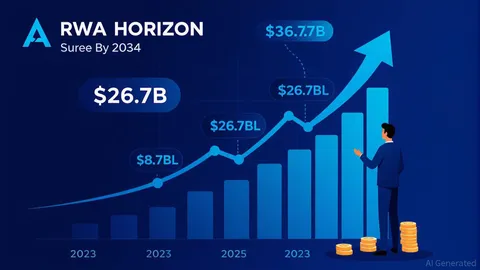
- Aave Horizon unlocks institutional liquidity by tokenizing real-world assets (RWAs) like U.S. Treasuries and real estate, enabling stablecoin borrowing and yield generation via DeFi. - The RWA market surged to $26.71B by August 2025 (260% YTD growth), with Ethereum hosting 51.93% of value and BlackRock’s tokenized fund expanding from $649M to $2.9B. - Partnerships with JPMorgan, Franklin Templeton, and the U.S. Senate’s GENIUS Act validate Aave Horizon’s hybrid model, blending TradFi compliance with DeFi

ainvest·2025/08/28 11:39
Ethereum ETFs Outperforming Bitcoin: A Strategic Shift in Institutional Capital Allocation

- Q2 2025 saw institutional capital shift to Ethereum ETFs, capturing $13.3B inflows vs. Bitcoin's $88M. - Ethereum's 4-6% staking yields, regulatory clarity, and DeFi infrastructure drove its institutional adoption. - SEC's utility token reclassification and in-kind mechanisms boosted Ethereum ETF confidence. - Institutional portfolios now favor 60/30/10 allocations (Ethereum/Bitcoin/altcoins) for yield and stability. - Ethereum's 90% lower L2 fees post-Dencun upgrade solidified its infrastructure dominan

ainvest·2025/08/28 11:39
Flash
14:46
BIS Warns Stablecoins Could Undermine Global Financial Stability
• The BIS says stablecoins risk fragmenting the global financial system. • Officials warn dollar-backed tokens could weaken monetary sovereignty. • The institution is promoting Project Agorá as an alternative framework. The Bank for International Settlements (BIS) has intensified its criticism of private stablecoins, warning they could fragment the global monetary system and create new risks for financial stability. In the 2026 Annual Economic Report, the institution argues that privately issued digital currencies cannot deliver the core characteristics of sovereign money and instead promotes a unified tokenized payment infrastructure built around central banks and regulated commercial banks. BIS Questions Stablecoins’ Ability to Function as Money The Basel-based institution argues that stablecoins fail to satisfy one of the fundamental characteristics of modern monetary systems: the “singleness of money.” Under today’s financial system, one unit of sovereign currency maintains the same value regardless of whether it is held as central bank money, a commercial bank deposit or physical cash. According to the BIS, privately issued stablecoins cannot consistently guarantee that property because they can trade above or below their intended peg during periods of market stress. The report notes that stablecoins operate across multiple public blockchains that are often isolated from one another. Rather than creating a unified payment network, this structure results in separate digital ecosystems, or what the BIS describes as “walled gardens,” where liquidity, users and applications remain fragmented across competing ledgers. Officials argue that this lack of interoperability limits competition, reduces payment efficiency and complicates cross-border settlement. The BIS also warns that large-scale stablecoin redemptions could force issuers to liquidate reserve assets, including U.S. Treasury bills, creating broader stress in traditional money markets through rapid asset sales during periods of financial instability. Dollar-Backed Tokens Raise Sovereignty Concerns Another major concern highlighted in the report is the growing adoption of U.S. dollar-backed stablecoins in emerging and developing economies. The BIS notes that households and businesses in countries experiencing high inflation or volatile domestic currencies increasingly use dollar-pegged stablecoins to preserve purchasing power and facilitate international transactions. While the trend may offer short-term financial benefits for users, the institution argues that widespread adoption could reduce the effectiveness of domestic monetary policy by shifting savings and payments away from local currencies. According to the report, continued expansion of dollar-backed stablecoins could accelerate digital dollarisation, reshape international capital flows and increase exchange-rate volatility, ultimately weakening central banks’ ability to manage inflation and support economic stability. Project Agorá Offers a Different Model Rather than opposing tokenization itself, the BIS advocates integrating blockchain technology into the existing financial system through Project Agorá. The initiative brings together eight central banks and more than 40 regulated commercial financial institutions to develop a unified ledger capable of supporting programmable payments and continuous cross-border settlement. Under the proposed framework, tokenized central bank reserves would serve as the settlement foundation, while commercial banks would issue tokenized deposits that remain fully interchangeable with sovereign money. The BIS argues this structure preserves the existing two-tier banking system while delivering many of the technological benefits associated with blockchain, including faster settlement, programmability and 24-hour transaction processing. Unlike privately issued stablecoins circulating across separate public blockchains, the unified ledger is designed to provide a common settlement infrastructure where different financial institutions can transact seamlessly. Regulators Call for Coordinated Global Rules The report arrives alongside renewed calls for international regulatory coordination. Earlier this week, the BIS Financial Stability Institute urged policymakers to accelerate work on common global standards for stablecoins, warning that fragmented national regulations could encourage regulatory arbitrage and deepen financial fragmentation. The institution argues that inconsistent legal frameworks would make cross-border supervision more difficult while allowing stablecoin issuers to operate under different regulatory standards across jurisdictions. The report underscores a growing divide in global policymaking. While jurisdictions including the United States have embraced regulated private stablecoins as part of their digital asset strategies, the BIS continues advocating tokenized commercial bank deposits backed by central bank money as the foundation of future digital payments. As governments increasingly define the next generation of financial infrastructure, the debate is expanding beyond technology to encompass broader questions of monetary sovereignty, systemic stability and who should ultimately control the issuance of digital money.
14:07
Mann: Labor market performance in some sectors is stronger than the overall unemployment rate
Bank of England Monetary Policy Committee member Mann stated that labor market signals in some sectors are not as weak as indicated by the overall unemployment rate.
14:04
Wells Fargo strategists recommend a tactical short on USD/JPY, targeting 155.80
According to Bloomberg, Wells Fargo strategists recommend tactically shorting the US dollar against the Japanese yen in the coming weeks, with a target level of 155.80 and a stop-loss at 163.20. Wells Fargo macro strategist Erik Nelson stated that the risk of intervention by Japanese authorities is rising, and the threshold for a Federal Reserve rate hike in July is extremely high.
News