
News
Stay up to date on the latest crypto trends with our expert, in-depth coverage.


Cryptocurrencies continue to "crash" on Monday, with some tokens falling back to the flash crash lows of October
Institutional demand for Bitcoin has fallen below the rate of new coin mining for the first time in seven months, suggesting that major buyers may be pulling back.
ForesightNews·2025/11/04 07:01

How Zcash reclaimed the privacy crown from Monero
CryptoSlate·2025/11/04 07:00

BlackRock’s $213 Million Bitcoin Move Exacerbates Fears of Sub-$100,000 Drop
BlackRock’s $213 million Bitcoin transfer to Coinbase has rattled traders, reigniting fears of a drop below $100,000.
BeInCrypto·2025/11/04 06:54
Crypto Market Crash: Henrik Zeberg Says Capitulation Is Setting Stage for a Massive Bull Run
Coinpedia·2025/11/04 06:51
Ripple Unlocks 1 Billion XRP Amid Market Weakness What It Means for Investors
Coinpedia·2025/11/04 06:51
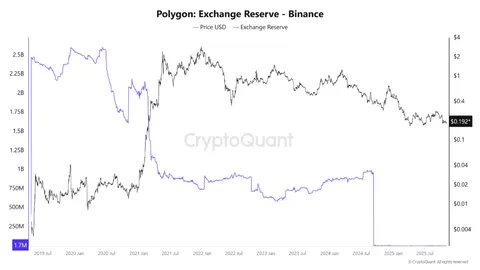
Can Polygon Rise 500%? A Look at Polygon Price Prediction 2025
Coinpedia·2025/11/04 06:51
Cycle Scientist Says No Altcoin Season Is Coming as Bitcoin Nears Its Peak
Coinpedia·2025/11/04 06:51
Crypto Bloodbath: Bitcoin and Ethereum Drop Sharply Amid Market Sell-Off
Coinpedia·2025/11/04 06:51
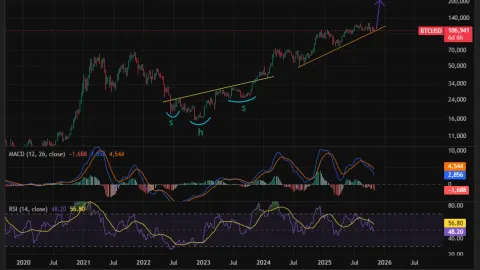
Bitcoin Price Drop is Likely a Pause and Not a Reversal; LMAX Strategist Joel Kruger Says
Coinpedia·2025/11/04 06:51
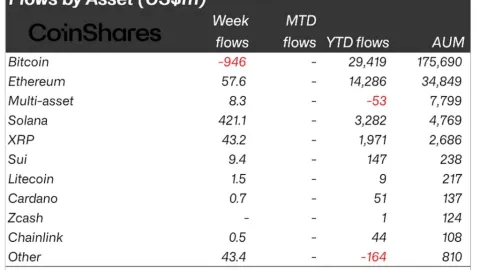
Solana Whales Aggressively Accumulate Amid Midterm Bearish Sentiment
Coinpedia·2025/11/04 06:51
Flash
05:56
Opinion: Anthropic Export Control Compliance Highlights Centralization Risks in AI, Decentralized AI Could Become Key Counterbalancing ForceBlockBeats News, June 14th, CoinFund founder Jake Brukhman stated that AI models naturally have centralizing attributes, making them a key target for government regulation and control. Anthropic's latest export control compliance action further confirms this trend.
He pointed out that decentralized networks can be a crucial counterbalance to the current situation, building sovereign, open, and public decentralized AI. The core challenge lies in the issue of computational power. Although it is widely believed that only trillion-dollar tech companies can afford cutting-edge model training, there is actually abundant global GPU computational power available. The key is to develop new distributed training algorithms.
Brukhman mentioned that teams such as Gensyn, Prime Intellect, Bagel, Pluralis, Nous Research, Macrocosmos AI, and Covenant AI have been exploring this direction. Although early on it was commonly believed to be infeasible, the reality has shown that distributed training can not only be achieved but also at a lower cost and with efficiency close to traditional solutions.
Furthermore, he believes that another major challenge facing decentralized AI is economic sustainability. While open-source models are important, they lack mature business models. Pluralis, by distributing model weights to participants, is exploring the commercial path of tokenizing AI models.
Brukhman stated that we are currently at a critical moment where AI will either move towards complete centralization, subject to scrutiny and unilateral government control, or establish a public AI on an open decentralized network, which will determine the industry's future direction.
02:59
A new address with a high leverage short position of 23,000 ETH, liquidation price $1863.2.BlockBeats News, June 14th. According to AI Auntie Monitor, address 0xa2e...f1468 started shorting 23,205.35 ETH in batches last night at 23:42, with a position value of $39.03 million, opening average price of $1,680.8, liquidation price of $1,863.2, and currently facing a floating loss of nearly $27,000.
02:41
Shipping Data: Strait of Hormuz Commercial Vessels Conduct Collective Diversion, Avoiding Iranian Waters to Redirect Toward Oman RouteBlockBeats News, June 14th, the latest ship tracking data shows that vessels passing through the Strait of Hormuz are significantly avoiding Iranian waters and instead opting for the Omani side channel. In the past 24 hours, no commercial vessels have used the Iranian side transit channel, and all related shipping activities have been concentrated in the Omani side traffic separation scheme.
Analysts state that due to increased regional security and geopolitical risks, shipping companies are proactively adjusting their routes to reduce potential risks of navigating near Iranian waters, leading to a further shift of the traditional transit structure towards the southern side (Oman direction).
U.S. President Trump posted on his personal social media platform at 00:45 a.m. this morning, stating that the Iran nuclear deal is scheduled to be signed tomorrow, and after signing, the Strait of Hormuz will be immediately opened to all countries. He mentioned that the relationship between the U.S. and Iran will be more positive than in previous administrations, and the agreement does not involve any funds being paid to Iran.
Trump also stated that once the situation stabilizes, the U.S. will deal with nuclear material buried deep underground in Iran and destroy it through a dilution process, which may take place in Iran or the U.S. He emphasized that he hopes to establish long-term cooperation with Iran and the entire Middle East region, but if the agreement cannot proceed smoothly, the U.S. still has an "ultimate alternative plan" and hopes to never have to use it again.
News