
News
Stay up to date on the latest crypto trends with our expert, in-depth coverage.

1Bitget UEX Daily | US Temporarily Lifts Sanctions on Iranian Oil; Semiconductor Sector Strong but Warnings Emerge; SpaceX Pullback Drags Tech Stocks2For 60 days, the United States temporarily lifts sanctions on Iranian oil, marking the first time in decades!3Aluminum: The "energy metal" facing a supply gap
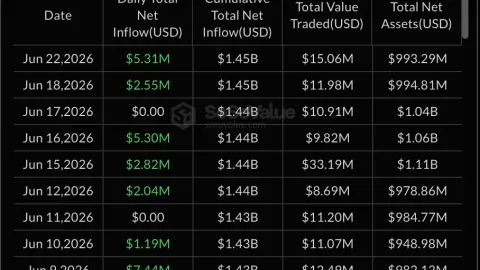
Bitwise XRP ETF inflows top $200m as demand holds
Crypto.News·2026/06/23 07:27
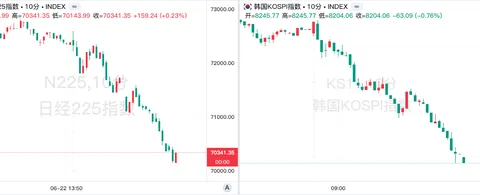

Japanese Yen: Downside bias as BoJ lags Fed – MUFG
FXStreet·2026/06/23 07:24
Arthur Hayes: “When the AI Bubble Bursts, Cryptocurrencies Will Be People’s Escape Route”
BitcoinSistemi·2026/06/23 07:15
CME Group restores CME Direct after four-hour outage rattles futures traders
Cryptobriefing·2026/06/23 07:15
AUD/USD Price Forecast: Tests descending channel bottom around 0.6950
FXStreet·2026/06/23 07:15
Market analysis company Swissblock reveals Bitcoin’s biggest risk! Here are the details
BitcoinSistemi·2026/06/23 07:12
Watch Out for the Bear Market Resistance Band: Analyst Discusses the Fate of Bitcoin and Altcoins
BitcoinSistemi·2026/06/23 07:12
Cardano Founder Charles Hoskinson Responds to Criticism That He “Doesn’t Care About the ADA Price”
BitcoinSistemi·2026/06/23 07:12
Flash
07:35
A dormant whale address after 7 years has started selling ETH, earning a profit of $41 million.Foresight News reports, according to Onchain Lens monitoring, a whale address that had been dormant for 7 years has started selling ETH. Currently, this address has sold 1,100 ETH through CoW Swap, exchanging it for 1.9 million USDS and making a profit of 41 million US dollars. The whale originally purchased 27,586.48 ETH for 5.72 million US dollars. It still holds 26,486.48 ETH, worth approximately 44.86 million US dollars.
07:32
TrendForce: DRAM Shortage Extends to DDR2, Prices of Older Memory Expected to Rise in Q3BlockBeats News, June 23rd – The high-tech industry research firm TrendForce announced in a study released on June 22nd that the tight supply of mature process node DRAM is forcing consumer-grade DRAM buyers to shift to earlier-generation memory products to secure more supply allocation. This shift is driving up demand for traditional DRAM such as DDR2 and DDR3, and sustaining the price uptrend of related products.
The firm projects that the contract price of DDR2 will increase by around 55% to 60% in the second quarter of 2026, with a further increase of 35% to 40% in the third quarter. This means that after a strong increase in the first quarter, the price pressure on DDR2 has not eased but instead intensified due to the widening supply-demand gap.
The core reason on the supply side is the reallocation of advanced process node capacity. TrendForce points out that the three major DRAM manufacturers are still prioritizing capacity for HBM and server DRAM to meet the demand from AI infrastructure development. Consequently, the wafer allocation for DDR4 and other mature process node products has been compressed, driving consumer-grade DRAM customers to seek support from Taiwanese suppliers.
In a situation of limited supply, Taiwan-based DRAM manufacturers such as Nanya Technology and Winbond have increased their bargaining power. TrendForce stated that as demand significantly outstrips the bit shipments these Taiwanese manufacturers can provide, suppliers are strategically reducing the production of low-margin products and shifting capacity to higher-value products to improve their profit structure.
Changes are also occurring on the demand side. With shortages of consumer-grade DRAM and rising contract prices, some OEM and ODM manufacturers have begun downgrading memory specifications to control overall system costs. Designs that originally used DDR4 have been switched to DDR3, and some DDR3 products are further transitioning to DDR2. Customers are trying to secure relatively stable supply through lower-capacity configurations or older-generation products.
This has led to a cascading shortage of DRAM across technology generations. The previous supply tightness mainly concentrated in HBM, server DRAM, and DDR4 is now spreading to traditional products like DDR3 and DDR2, highlighting the squeeze on the entire memory industry chain due to AI demand.
TrendForce mentioned that the main suppliers of DDR2 include Winbond and JHCTECH. However, Winbond is gradually reducing DDR2 production and shifting related capacity to higher-margin products such as DDR3, DDR4, and LPDDR4, further exacerbating the tight supply of DDR2.
In contrast, Powerchip plans to maximize DDR2 production within its existing wafer allocation at Vanguard International Semiconductor (VIS), focusing resources to enhance the profitability of this product line and partially fill the supply gap left by Nanya's departure from the DDR2 market.
This round of price increases demonstrates that the memory demand driven by AI is no longer limited to high-end HBM and server DRAM. As advanced capacity is reallocated, mature processes and legacy memory products are also becoming pressure points of supply and demand imbalance. For consumer electronics, industrial control, and some long-life-cycle devices that still rely on DDR2 and DDR3, cost pressures may continue to rise in the second half of the year.
07:24
The yield on the 10-year US Treasury note has fallen by 0.53% today, currently at 4.482.The yield on the 10-year US Treasury has fallen by 0.53% today, now at 4.482.
News